Hugo Fischer · 13 October 2026
Cache Synchronization Challenges Across Multi-Region Deployments in Jade Systems
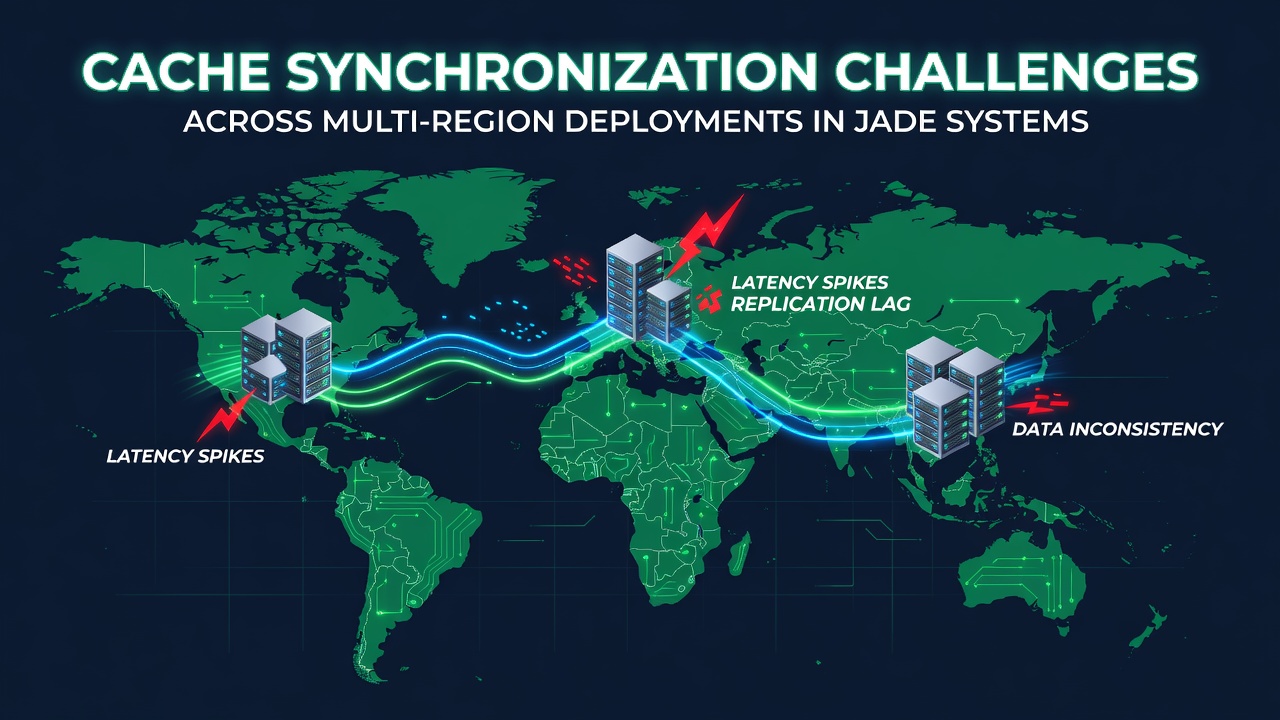
Multi-region deployments in Jade Systems require cache layers to maintain data consistency while serving requests from locations that span continents, and observers note that network variability introduces delays that affect how updates propagate between nodes. Researchers have documented how these setups balance availability against strict consistency guarantees, particularly when traffic patterns shift rapidly during peak hours.
Core Mechanics of Cache Propagation in Distributed Jade Environments
Jade Systems rely on asynchronous replication protocols to push cache entries from primary regions to secondary ones, yet propagation times vary based on distance and routing paths, which creates windows where stale data persists. Data indicates that typical round-trip latencies between North American and European nodes range from 80 to 150 milliseconds, while Asia-Pacific connections often exceed 200 milliseconds under load.
Engineers configure write-through or write-behind strategies depending on the workload, and studies reveal that write-behind approaches reduce origin server pressure but increase the risk of temporary divergence across caches. Those who manage large Jade deployments track these patterns through metrics that capture both hit ratios and replication lag.
Network Partitions and Their Impact on Synchronization
Network partitions occur when connectivity between regions degrades or drops entirely, forcing individual caches to operate independently until links restore. Evidence from distributed system logs shows that such events trigger fallback behaviors where local nodes continue serving from their last known state, which can lead to conflicting updates once communication resumes.
Conflict detection mechanisms in Jade Systems compare timestamps and version vectors to identify discrepancies, after which resolution rules apply either last-writer-wins logic or application-specific merges. Research indicates that the frequency of these conflicts rises during maintenance windows or regional outages, with October 2026 reports highlighting several incidents where multi-hour partitions affected global consistency.
Consistency Models Applied Across Regions
Eventual consistency remains the default choice for many Jade cache configurations because it prioritizes availability and partition tolerance, allowing reads to return values that may not yet reflect the latest writes from distant regions. Stronger models such as causal consistency demand additional coordination overhead, which some operators accept when dealing with financial or inventory data that tolerates no divergence.
According to analyses from the National Institute of Standards and Technology, selecting the appropriate model requires mapping data sensitivity to acceptable staleness thresholds, and teams often implement hybrid approaches that apply stricter rules only to designated cache keys. NIST publications on distributed systems outline evaluation criteria that help quantify these trade-offs in production settings.
Monitoring and Observability Practices
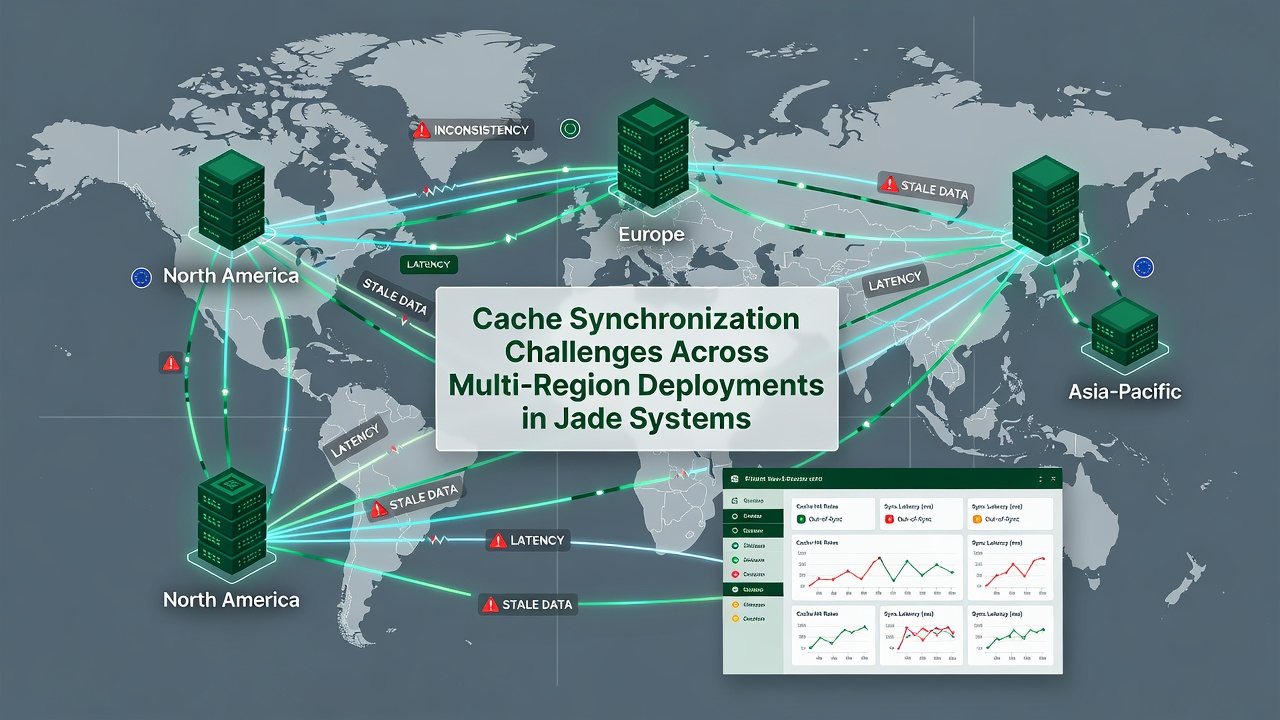
Teams instrument Jade deployments with distributed tracing tools that follow cache operations across region boundaries, revealing bottlenecks that single-region monitoring misses. Metrics collected in October 2026 showed elevated replication lag during cross-Atlantic traffic spikes, prompting adjustments to batch sizes and compression settings.
Alert thresholds for synchronization drift help operators intervene before user-facing inconsistencies appear, and automated dashboards aggregate data from all active regions to present a unified view. Observers note that combining these signals with synthetic transaction tests provides earlier warning than log analysis alone.
Scaling Considerations for Growing Deployments
As Jade Systems expand into additional regions, the number of synchronization paths multiplies and creates quadratic growth in coordination messages. Techniques such as hierarchical replication and regional leaders reduce this overhead by limiting direct communication between every pair of nodes.
Performance evaluations conducted by academic groups, including work from the University of Melbourne on large-scale caching, demonstrate that hierarchical designs maintain lower average lag even as region counts increase beyond five. University of Melbourne research on these topologies offers comparative benchmarks across different network conditions.
Conclusion
Cache synchronization in multi-region Jade Systems continues to present measurable engineering challenges around latency, conflict handling, and model selection, with operational data from 2026 underscoring the need for adaptive monitoring. Organizations address these issues through protocol refinements and targeted instrumentation that keep divergence within acceptable bounds while supporting global scale.