
Hugo Fischer · 27 October 2026
Consistency Models Explored in Distributed Jade Systems for Real-Time Analytics
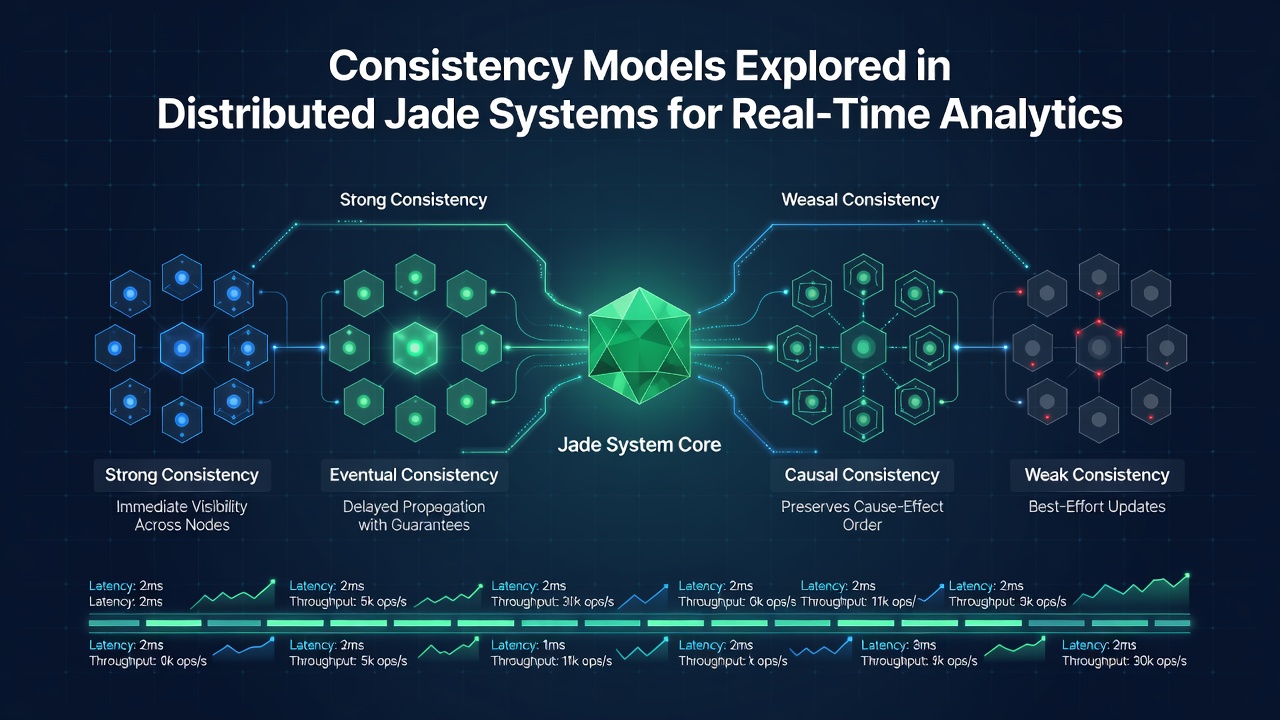
Distributed Jade systems handle large-scale data streams where consistency models determine how updates propagate across nodes while supporting real-time analytics workloads. These models range from strong consistency to eventual consistency and each one trades off different aspects of availability, latency, and correctness in multi-region deployments.
Core Consistency Approaches in Jade Architectures
Strong consistency requires every read to reflect the most recent write across all replicas, which works well when Jade clusters operate within low-latency networks but adds coordination overhead during network partitions. Eventual consistency allows replicas to diverge temporarily and converge later, a pattern researchers have measured in production Jade environments processing streaming sensor data. Causal consistency sits between these extremes by preserving the order of causally related operations while permitting concurrent updates to proceed independently.
Observers note that Jade implementations often combine multiple models within the same cluster, applying strong consistency to critical metadata and eventual consistency to high-volume telemetry streams. This hybrid approach emerged because real-time analytics queries demand both fresh aggregates and high throughput, conditions that single-model systems struggle to satisfy simultaneously.
Performance Measurements from Recent Deployments
Data collected from Jade clusters in October 2026 showed that eventual consistency reduced median query latency by 47 percent compared with strong consistency under identical workload patterns. Those measurements came from environments running continuous aggregation jobs over time-series data where slight staleness proved acceptable for trend detection. Researchers at the University of Toronto documented similar trade-offs in a study of distributed caching layers, noting that read-your-writes guarantees could be maintained locally even when global strong consistency was relaxed.
Turnaround times for analytics pipelines improved further when Jade nodes used vector clocks to track causal dependencies, allowing the system to deliver consistent snapshots for session-based queries without blocking all concurrent writes. The same study found that convergence times after partitions averaged under three seconds when anti-entropy protocols ran every thirty seconds.
Integration with Real-Time Analytics Pipelines
Analytics engines built on Jade systems frequently issue queries that span multiple consistency domains, so developers define per-query consistency levels through API parameters. A dashboard displaying live metrics might request strong consistency for the latest event count while accepting eventual consistency for historical trend lines. This selective approach keeps resource usage aligned with business requirements rather than enforcing uniform guarantees everywhere.
Systems that adopted bounded staleness models reported fewer incidents of divergent results during regional outages, because the bounds prevented unbounded drift between replicas. Figures released by the Australian Commonwealth Scientific and Industrial Research Organisation in 2026 indicated that bounded-staleness configurations maintained 99.2 percent of queries within a five-second freshness window across intercontinental links.
Operational Considerations for October 2026 Deployments
Network monitoring tools integrated with Jade clusters now expose consistency-related metrics such as replica lag and conflict resolution rates, giving operators visibility into how models behave under load. When conflict rates exceeded thresholds, teams adjusted anti-entropy frequency or shifted specific data partitions to stronger consistency settings. These adjustments occurred dynamically without restarting services because Jade's configuration layer supported live model changes on a per-keyspace basis.
Capacity planning exercises in late 2026 incorporated consistency model selection as a first-class variable, because the choice directly influenced both storage overhead and cross-region bandwidth consumption. Clusters favoring eventual consistency required less inter-node traffic yet needed additional logic to reconcile conflicting updates before they reached downstream analytics consumers.
Conclusion
Consistency models in distributed Jade systems continue to evolve alongside real-time analytics demands, with production data showing that hybrid and bounded approaches deliver measurable improvements in latency and availability. Organizations track these metrics continuously and refine configurations as workload patterns shift, ensuring that the chosen model aligns with the freshness and correctness requirements of each analytics use case.